.avif)
In this guide you’ll learn how closed-circuit rebreather (CCR) diving works, the advantages of using a CCR, and the pathway to becoming CCR qualified.
What is a closed-circuit rebreather?
Human beings are very inefficient respiratory creatures. As you’re reading this article, you’re breathing in air that contains 21% oxygen. Yet your body will use only a fraction of that oxygen; the air you breathe out will still have an oxygen content of 17%.
A closed-circuit rebreather is a device you can use as a diver to make much more efficient use of every breath you take underwater. It works by recycling the air you exhale, removing carbon dioxide and adding back in enough oxygen so you can breathe it again. In other words, you recycle every breath.
As you’ll see below, this provides several advantages, including more time at depth with lower decompression penalties.
Key differences between CCR versus open circuit scuba
On open circuit, every breath you exhale is lost as bubbles in the water, including that 17% oxygen. That limits your gas supply to what you can carry on your back. The deeper you go and the harder you work, the faster your gas will run out.
CCR changes the equation. By recycling exhaled breath, you use up the gas in your cylinders at a much slower rate. Less gas is wasted, dive times can be longer, and you can save money on expensive gases like helium.
How does a rebreather work?
The diver exhales through a one-way valve on one side of the mouthpiece (typically the right-hand side). The exhaled gas then passes through a canister of material that absorbs CO2. The gas then arrives at a sensing array, connected to a computer, which checks the oxygen level of the exhaled gas and responds to that reading by signaling how much oxygen needs to be added from the oxygen supply on the rebreather.
The exhaled gas, scrubbed of waste products and topped up with oxygen to bring it back to the required level, comes back through a hose on the diver’s opposite shoulder and through another one-way valve to be inhaled through the mouthpiece.
Rebreather components
The main components of a CCR are:
- Mouthpiece – held in the mouth like a snorkel.
- One-way valves – gas can only flow one direction round the loop (on most units, exhale to the diver's right, inhale from the left).
- Breathing hoses – carry gas over the shoulders and around the loop.
- Canister with CO2-absorbent material – scrubs carbon dioxide from the exhaled gas.
- Sensing array – measures the oxygen levels of exhaled gas and has redundancy by the use of a minimum of 3 oxygen sensors.
- Oxygen replenishment system – adds oxygen back in, either manually or via an electronically controlled solenoid valve.
- Counterlung(s) – at least one flexible bag in the circuit that expands and contracts with the diver’s breathing, so there's something to physically breathe into and out of (think of the difference between trying to breathe out into a glass bottle versus a paper bag).
- Gas supply – oxygen (for replenishment) plus a diluent gas (to dilute oxygen so it isn't toxic at depth. This tends to be air at lower depths, then trimix and so on as depth increases).
How long can you stay underwater and how deep can you dive with a rebreather?
This question requires a nuanced answer, and depends on equipment used and a diver’s training. The only internationally recognized certification for closed circuit breathing apparatus for use underwater is CE-EN 14143. Under this certification, equipment is certified to 100 meters. As for how long you can stay underwater, under this certification it’s 180 minutes.
Note, however, that there are some limited-duration rebreather systems that are used for emergency bailout from a failed umbilical supply which have a deeper certification.
As for training, several agencies, including the one DEEP uses, offer ISO-approved training up to 100 meters. It’s worth pointing out that many practitioners believe that, having made the switch to rebreather, all dives should be made on a rebreather even at shallower depths, in order to maintain a single skillset and immediate response skills. A rebreather can also offer huge advantages on shallow long-distance cave dives (less than 10 meters) due to being much more gas efficient than SCUBA.
Different types of rebreather systems
There are two main types of CCR system:
- Manual CCR (MCCR) – the diver manually injects gas via a button. An obvious issue here is that the diver may forget to do this, so MCCRs can also have a mechanical backup feed that trickles life-sustaining gas at a slow, constant rate.
- Electronic CCR (ECCR) – with an ECCR, sensors and a computer automatically maintain the oxygen level of the gas in the system. The diver can still manually override this process, for instance to run the system more efficiently or reduce decompression time. If the diver stops manually managing it, the ECCR will maintain "life support".
There are also different options when it comes to where the CCR system is placed on a diver’s body:
- Back mount is a large single unit worn like a rucksack.
- Side mount units are worn under the arm, down the side of the body.
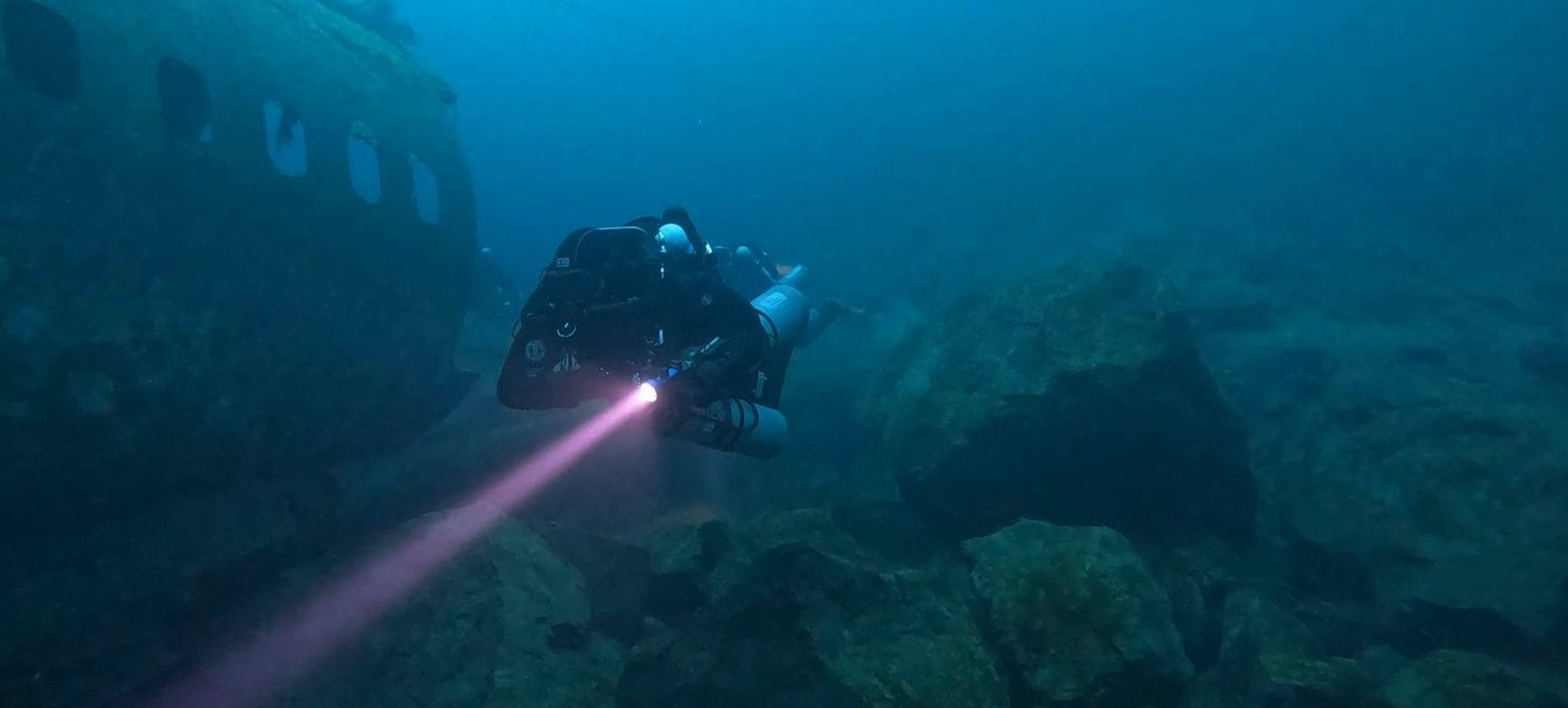
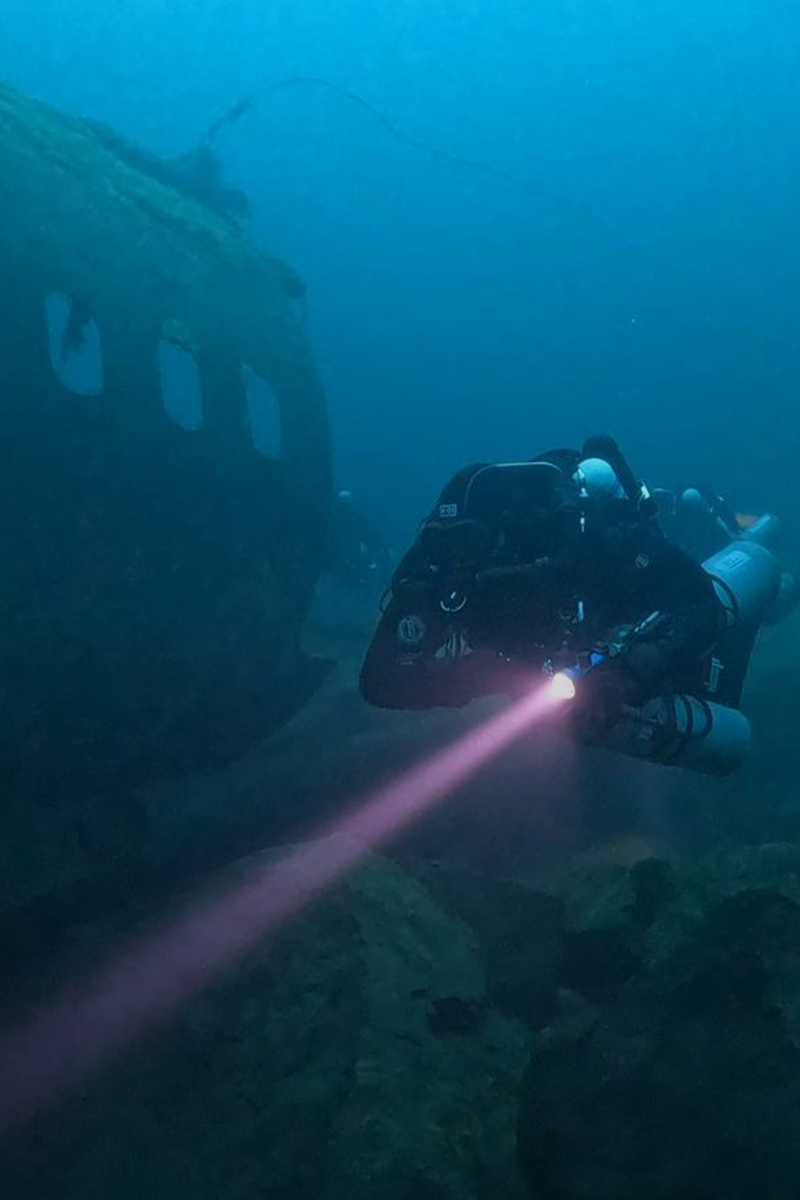
A side mount configuration can be useful for confined spaces, such as small caves or shipwrecks where a back mount rig would make the diver too bulky to fit.
A side mount also allows a second CCR unit to be carried as redundancy as an alternative to bailing out to open circuit. For example, a diver could have a back mount ECCR as their primary with a side mount MCCR or ECCR as bailout. Or two side mount units for long, tight cave dives.
Why do divers choose CCR and where does it sit in diving progression?
A standard diving progression path typically starts with open water, then advanced open water, followed by a rescue diver course so diving pairs can look after each other.
From rescue, the path splits. Some stay as recreational divers and progress to divemaster and instructor. Others move into technical diving to extend the range at which they can dive, for instance using double cylinders, nitrox or mixed gases, and some limited decompression. However, technical divers rapidly discover that helium is prohibitively expensive when used on open circuit at depth (at just 30 meters you use four times as much gas per breath as you do on the surface). It doesn’t make financial sense to pay for gas and expel it into the ocean after a single breath.
Combine that with the ever-increasing size (and weight) of cylinders needed to go deeper and it’s clear why divers gravitate towards CCR. A fully rigged rebreather weighing around 40kg offers a more manageable way to dive, for lower cost, and with more time on the bottom.
When is CCR not suitable?
If a dive requires hard physical exertion, for example a commercial working dive, a rebreather is not the best option because a higher respiration rate can push exhaled breath through the CO2 absorbing canister before the chemical reaction that absorbs the CO2 has time to occur.
For example, I’ve managed maritime archaeology scientific diving projects where I’ve switched from CCR to open-circuit SCUBA for tasks such as hand-sawing a wood sample from a segment of hull for dendrochronology analysis, and recovering a Roman anchor stock that had become encrusted into the seabed. Both of these tasks were done at relatively shallow depths, but the physical effort meant open circuit was a better option than CCR.
Career opportunities associated with CCR
The traditional route is becoming a rebreather instructor, which is a long journey through diver qualifications and then multiple levels of instructor certification.
More recently, there have been opportunities open up in diving media (photography and videography), diving science, and diving supervision. Before joining DEEP, I was a diving safety officer and a diving operations manager for a variety of scientific institutions around the world, such as Lund University, Woods Hole Oceanographic Institute, the US National Park Service, and the Greek Ephorate of Antiquities. I trained scientists to dive CCR so they could carry out projects like maritime archaeology on the Antikythera wreck, and recovering WWII servicemen for the US DPAA.
CCR training at DEEP
DEEP offers four levels of CCR training that build experience and increase capabilities at a comfortable pace:
- CCR 1 Air Diluent No-decompression Diver (30 meters)
- CCR 2 Air Diluent Decompression Diver (40 meters)
- CCR 3 Helitrox Decompression Diver (45 meters)
- CCR 4 Mixed Gas CCR Decompression Diver (60 meters)
Students can expect a gradual introduction to the transition to CCR diving with education focusing on understanding and mastering the component skills, followed by integration of those skills into realistic scenarios to develop a real-world capability. The above levels are interspersed with required mandatory dive numbers and hours.
DEEP Campus offers a unique water space to facilitate the depth-incremental requirements of the CCR training syllabus. Students benefit from a sheltered inland facility with crystal clear water and numerous underwater objects and attractions to train on.
DEEP’s Rebreather training staff bring more than three decades of diver education and have over 6000 dives of experience (4000+ hours on CCR) from real-world CCR diving projects in scientific, media, and exploration environments.
What makes a good CCR diver?
In a word, discipline. It really helps to enjoy the process of undertaking rigorous pre-dive checks every single time, much like an airline pilot does before takeoff. When things go wrong, it’s pretty much always because these checks were skipped or shortcuts were taken. If you like that kind of ritual, then you should love CCR diving.
It’s also important to have a commitment to avoiding skill fade. Regularly practicing bailout and emergency drills matters as much as the initial certification. You need those skills to be there under stress when something does go wrong.
What kind of diving experiences does CCR unlock?
To give you an idea of the kind of dives CCR enables you to do, here are just a couple of my most memorable dives:
- Cave diving the Devil's System, North Florida (Ginnie Springs): About an hour into the cave, I laid a jump line into an unlined stretch of passage to tie into a hidden guideline, which led to a section where the passage floor and walls are lined with fossilized whale vertebrae and ribs, preserved in limestone formed from ancient, compressed sediment. Diving this on open circuit, while technically possible, is highly impractical as you'd need to leave a trail of cylinders along the way, which you don’t need to do with a CCR.
- Porto Galera, Philippines: There’s a well-known rock formation around 70 meters down, where I was teaching mixed-gas rebreather students, that acts as a natural "cleaning station" for thresher sharks, where small fish clean parasites from larger fish. And the little cleaner fish come up and start picking at the dead skin on your hands, then the thresher sharks come in. And they just circle you. No aggression. And all they're doing is like someone driving around a car park waiting for a space. They're waiting for you to move so they can come onto the cleaning station for their turn to have their mouth and their teeth and their gills cleaned.
CCR and habitat diving
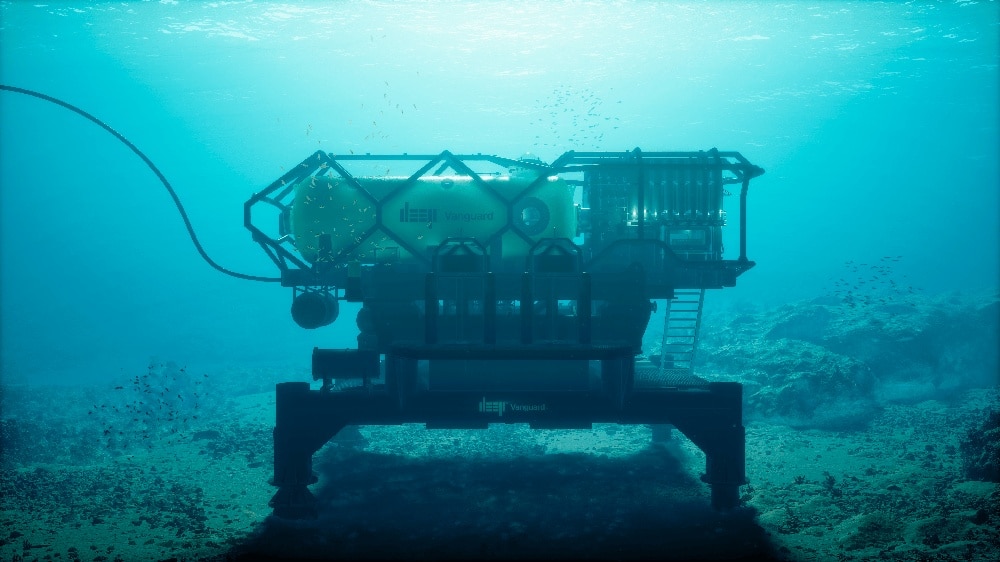
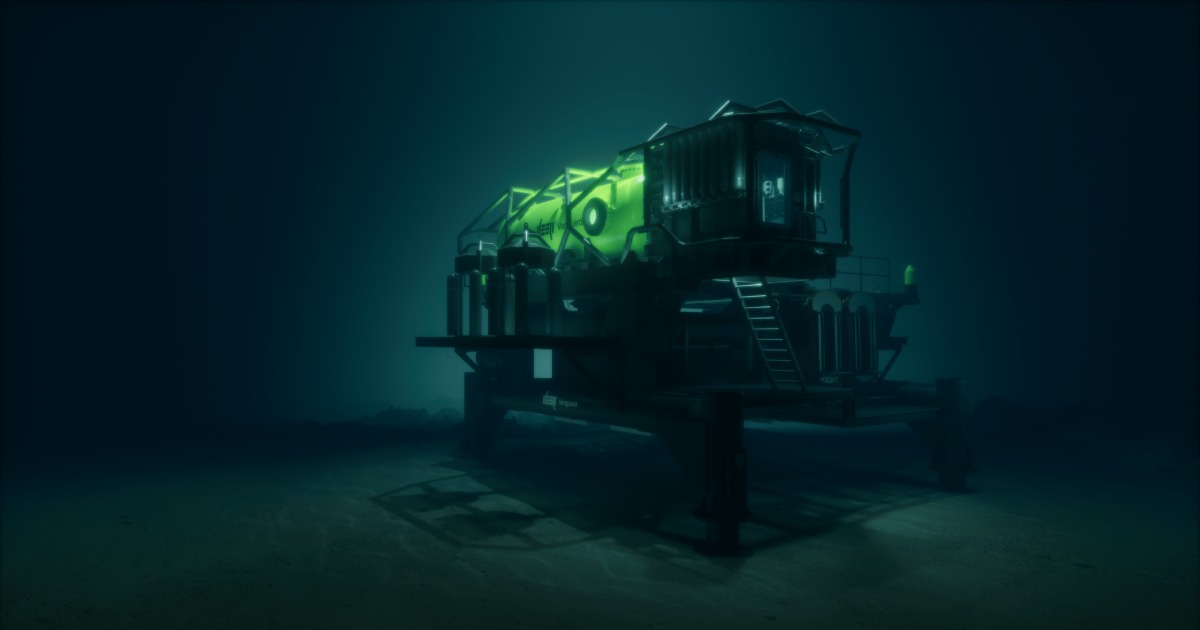
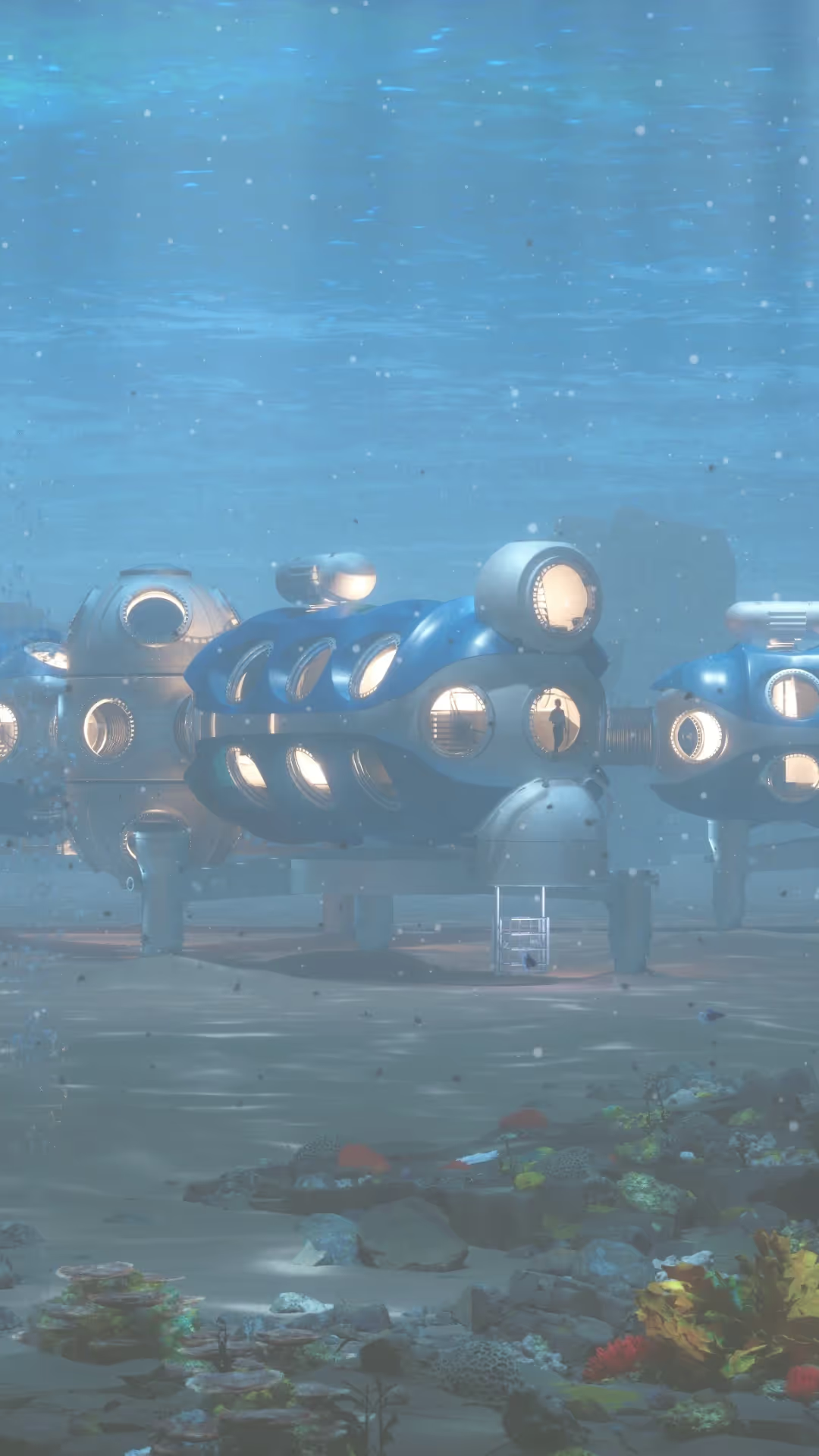
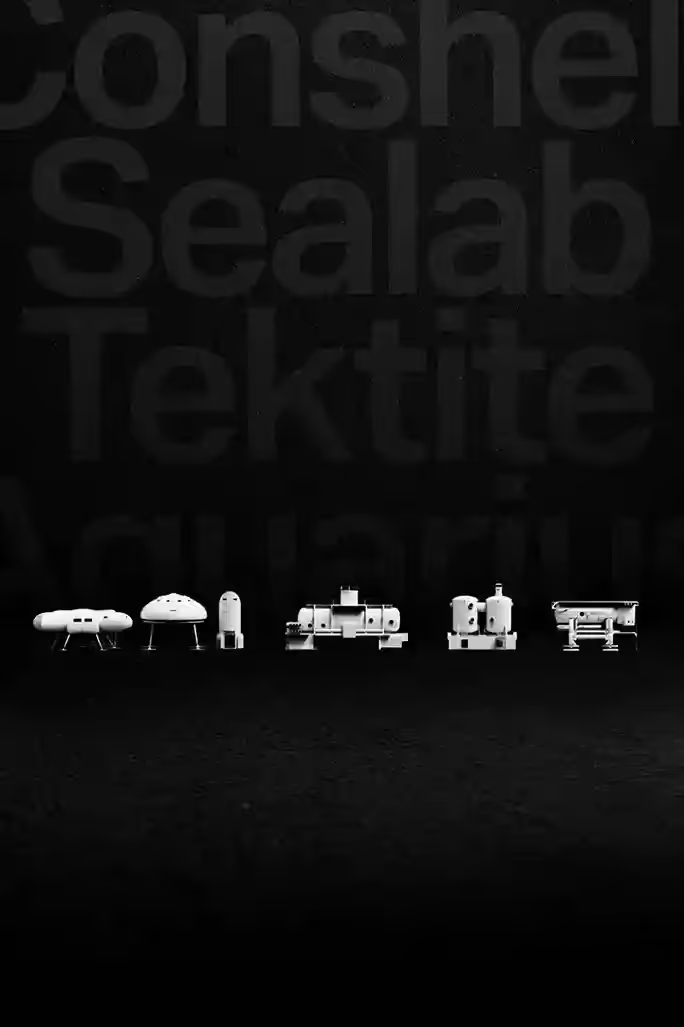
The point of subsea human habitats is to extend the amount of time divers have at depth to days or even weeks. So, while it’s possible to dive from a habitat on an open circuit, for the reasons above it can be wasteful of gas and substantially limit the time of a dive.
A common way to dive from a habitat, as is the case from a diving bell, is to supply air from an umbilical, with a rebreather acting as a backup in case the umbilical fails. It’s equally possible to reverse this, for example to conserve gas, and dive on the rebreather with the option of switching to an umbilical if the rebreather fails. Another option could be to dive on a rebreather with a secondary rebreather as backup, using a lightweight tether to guide divers back to the habitat.
DEEP provides closed-circuit rebreather training in Florida and the UK.
.png)
.png)
.avif)
.avif)
.jpg)


.avif)
.avif)